Labour Day

1 May 2026 Public holiday International Workers' Day Maypole & spring custom

In Austria, 1 May is the nationwide State Holiday, International Workers' Day and an important date for spring customs. For everyday planning, the key points are holiday rest, closed shops, events, outings and whether the date can become a long weekend. Here you can find everything you need to know about holiday rest, opening hours, bridge days and the best-known May customs.

Holiday rest, outings and maypoles

At a glance

Labour Day falls on Friday, 1 May 2026 this year. 1 May is a nationwide public holiday and also International Workers' Day and a date for May customs.

Date
1 May 2026
Falls on Friday this year.
Status
Nationwide public holiday
1 May is listed as the State Holiday in section 7 of the Austrian Rest Period Act.
Meaning
International Workers' Day
The international day of the labour movement has been visible in Austria since 1890.
Bridge days
3 free days
The planner shows the best free blocks later in the year.

Labour Day is one of the few fixed-date holidays in the Austrian calendar. It always falls on 1 May and therefore feels very different depending on the weekday: sometimes an automatic long weekend, sometimes a classic bridge day, and sometimes a barely noticeable weekend holiday.

In terms of meaning, the day has two layers. In cities, International Workers' Day with rallies, trade unions and political tradition often comes first. In many municipalities, maypoles, associations, music, spring festivals and outings shape 1 May instead.

For 1 May, first check whether you have the day off, which shops are closed, where May festivals take place and whether a leave day is worth it. Once that is clear, history, customs and offers are easier to place.

Holiday planning

Calculate bridge days

How to ideally use Labour Day for a long spring weekend.

3 free days without leave

3 free days without annual leave

This year, 1 May automatically extends the weekend.

Recommendation
Use the weekend
Block
1 May to 3 May 2026

This year, 1 May automatically extends the weekend. Looking at the calendar is especially useful in May because Ascension Day, Whit Monday and Corpus Christi often create additional free blocks. 1 May is the first fixed anchor in the month.

After that, the practical questions are short breaks, spa weekends, city trips, May festivals, outings, accommodation and travel.

Everyday practice

Everyday rules

What to look out for regarding shopping, errands and outings.

In everyday life, Labour Day behaves like a classic statutory public holiday: many routines pause, while leisure and tourism offers may be in particular demand for exactly that reason.

Work

Holiday rest

On Labour Day, public-holiday rest generally applies. Work on 1 May is only possible in legally permitted sectors or under the relevant employment-law consequences.

Shopping

Mostly closed

Regular supermarkets, shopping centres, banks and many public-office tasks pause. Typical exceptions are travel-supply locations, petrol stations, emergency services, restaurants and tourism businesses.

Events

Political & regional

In cities, rallies and May Day celebrations often shape the morning. In many municipalities, maypoles, music, fire brigades, associations and village festivals are the focus.

Outings

Spring day

1 May is a classic excursion day. Inns, spas, museums, mountain lifts and leisure destinations may be open, but often with public-holiday hours.

Legal situation

Employment law

Why Labour Day is legally treated differently from National Day.

From an employment-law perspective, Labour Day is clear: 1 May is explicitly named in the statutory public-holiday list. For most employees, it is therefore a day off with holiday rest. [1]

At the same time, there are sectors where public-holiday work is permitted or necessary. These include healthcare, care, safety, transport, restaurants, hotels, tourism, culture and technical services. Anyone working on 1 May should therefore check not only the holiday itself but also the collective agreement, duty roster and pay rules.

Section 7 ARG

The Austrian Rest Period Act explicitly names 1 May as the State Holiday. That makes it a nationwide statutory public holiday.

National Day is different

Austria's National Day is 26 October. Legally, 1 May is called the State Holiday and historically is mainly connected with International Workers' Day.

Public-holiday work

Anyone working in permitted sectors on the public holiday should check working time, pay, compensatory rest and supplements in the collective agreement or duty roster.

FAQ

Häufig gestellte Fragen

Is 1 May a public holiday in Austria?

Yes. Under section 7 of the Austrian Rest Period Act, 1 May is the State Holiday and a nationwide public holiday in Austria.

What is the difference between the State Holiday and National Day?

The State Holiday is 1 May. Austria's National Day is 26 October and refers to Austria's permanent neutrality. Both are public holidays, but they have different history and meaning.

Are shops open on Labour Day?

Regular shops and supermarkets are usually closed on 1 May. Exceptions include travel-supply locations, petrol stations, emergency pharmacies, restaurants and tourism businesses.

Why is 1 May International Workers' Day?

1 May goes back to the international labour movement. In Austria, it has been marked as a day for workers' rights since 1890 and became a statutory day of rest and celebration in 1919.

Why are maypoles erected?

The maypole is a spring and community custom. In many places, a decorated tree is erected on the village or main square, often accompanied by music, associations and festival activity.

Background & May customs

The background connects International Workers' Day, maypoles and rural spring festivals with the question of why 1 May works so well for outings, regional events and short breaks.

History

International Workers' Day

How a labour-movement day of action became an Austrian public holiday.

Internationally, 1 May is connected with the labour movement. Working hours, social rights, wages and the political visibility of employees were central issues. In Austria, the day has been marked since 1890 and quickly became an important date for organised labour.

In 1919, 1 May became a statutory day of rest and celebration in Austria. Today it is listed in the Austrian Rest Period Act as the State Holiday. This legal term often causes confusion because it is easily mixed up with Austrian National Day on 26 October.

The political origin remains part of 1 May: it is about work, social rights and trade-union history. Today, holiday rest, free time, maypole festivals, outings and regional events are also part of the day.

1890

1 May was first marked in Austria as a day of action for the labour movement. Working hours, rights and social security were central themes.

1919

In the young republic, 1 May became a statutory day of rest and celebration. A political day of action was thus also anchored in law.

May customs

Alongside its political meaning, 1 May lives on as a spring and village festival: maypoles, music, associations and regional food shape many places.

Tradition

Maypole & customs

How 1 May is celebrated as a spring and village festival.

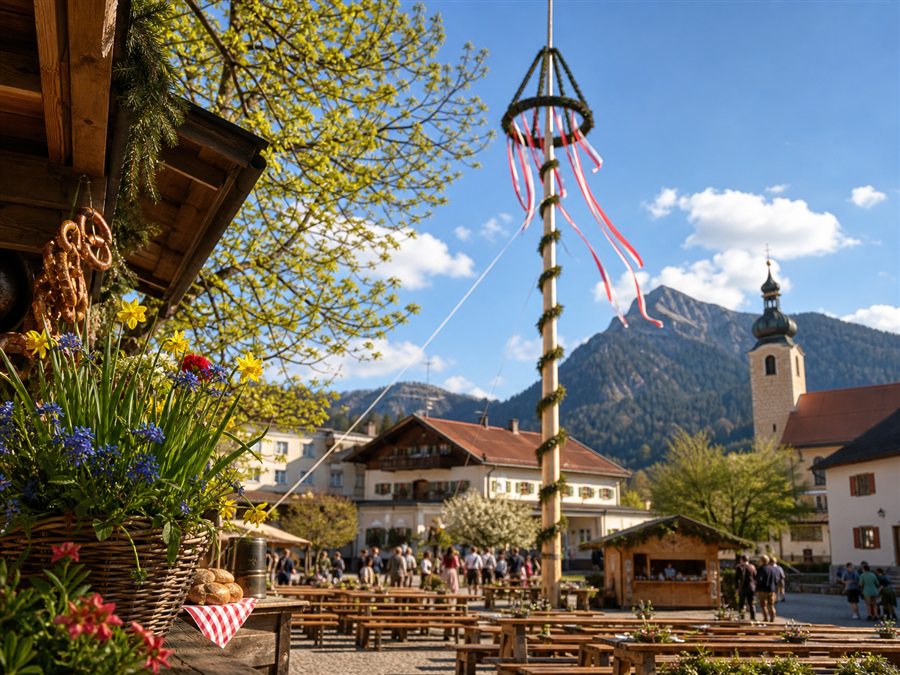
Away from city rallies, 1 May is closely connected with the maypole in many places. The decorated tree stands on the village or main square, is often accompanied by associations, fire brigades, music and food, and visibly marks the start of the warm season.

The custom varies strongly by region. Some places erect the tree on the evening before, others on 1 May itself. In some places it is still done by hand; in many places a crane is used for safety reasons. Guarding or stealing the maypole is also part of local custom in some regions, but should not be read as permission for damage or risky actions.

Many occasions form around the maypole: putting it up, maypole watches, village and town festivals, music, associations, regional markets, inns and nearby outings.

Season

Outings & food

Which outing destinations and regional offers suit the holiday.

1 May falls in the middle of the Austrian spring and is therefore a natural outing day. Many people combine the public holiday with a walk, a May festival, an inn visit, a spa, a first lake outing or a short trip to a neighbouring region.

Culinarily, the day works less through one fixed ritual than through festival life and seasonality: barbecue, sausages, regional cuisine, outdoor seating, coffee, cake, May punch or alcohol-free spring drinks fit especially well with the outing side.

Austrian spring outing and May celebration on 1 May
Next steps

Plan next

Useful tools to make the most of the rest of the holiday year.

Labour Day is the start of a May that is especially relevant for planning. Anyone optimising annual leave should check 1 May together with Ascension Day, Whitsun and Corpus Christi. Depending on the calendar year, a few leave days can create several long blocks.

For the next step, use the annual leave planner, the school-holiday calendar and the calendar-week overview.

Locally, the most relevant details are maypole festivals, excursion destinations, outdoor seating, spas, family programmes and event calendars in the relevant municipality or region.

Quellen & Weiterführendes

  1. RIS - Austrian Rest Period Act § 7 : nationwide public-holiday list; 1 May is listed as the State Holiday.
  2. oesterreich.gv.at - Sunday and public-holiday work : general guidance on work on Sundays and public holidays and possible exceptions.
  3. Austrian Trade Union Federation - 1 May, International Workers' Day : historical context for 1890, 1919 and today's meaning for workers' rights.
  4. Lower Austrian folk culture - May customs : maypoles, Walpurgis Night and regional customs around 1 May.
  5. Lower Austrian folk culture - maypoles : design, erection and current maypole practice.
  6. Austrian National Day : 26 October and the distinction from the State Holiday.
  7. Annual leave planner Austria : compare bridge days and long weekends in May.